
Allspring Global Investments: Shifting tides - EM equities back in focus

Global dynamics are shifting and emerging markets are at the heart of it. Driven by favourable macroeconomic dynamics, compelling valuations and a weakening US dollar, we explore why now may be the time to rethink your emerging market equities allocation.
By Alison Shimada
After a decade of relative underperformance, otherwise known as the ‘lost decade’, emerging market (EM) equities have captured the spotlight in 2025. The MSCI EM Index has delivered a robust 27.5% return year to date1, outpacing many developed market (DM) peers. This resurgence is not a fleeting rebound, it reflects a structural shift in global dynamics that investors can no longer afford to ignore.
Whilst the shift took a little longer than expected, the strength of the rebound has exceeded our expectations. We believe the tipping point is here for the asset class and for what we like to call Emerging Markets 2.0: a phase of renewed growth and resilience, defined by stronger fundamentals.
Emerging Markets 2.0 is powered by several key developments:
- The waning of US exceptionalism: while the US remains a dominant force, its relative outperformance is moderating. This opens the door for investors to diversify into other regions.
- A weakening US dollar: historically, EM equities have outperformed during periods of dollar weakness. With the US Federal Reserve nearing the end of its tightening cycle, this trend is likely to continue.
- Structural growth drivers: from India’s demographic dividend to China’s technological innovation, EMs are home to some of the world’s most dynamic economies.
- AI and the global supply chain: the rise of AI is not just a developed market story. EMs are integral to the AI supply chain, from semiconductors to rare earth materials, reinforcing their strategic importance.
For those of us who have been navigating emerging markets for decades, the recent momentum is a welcome change. Although it’s prudent to be cautious, those key developments outlined suggest this isn’t just a fleeting rally but a potential structural shift.
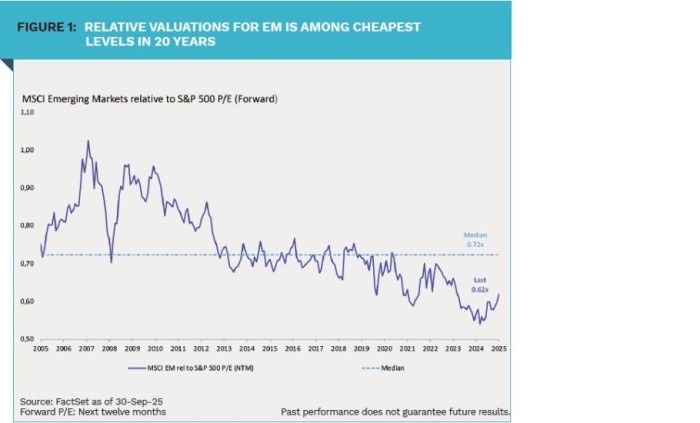
Valuations and shareholder returns Valuations in EM equities remain compelling.
The asset class trades at a significant discount to developed markets, with forward earnings (NTM) at 14.02 times and a price/book ratio of 1.88 times. But valuation alone isn’t the story.
We believe the tipping point is here for the asset class and for what we like to call Emerging Markets 2.0: a phase of renewed growth and resilience, defined by stronger fundamentals.
A recent MSCI study, on which we partnered earlier this year, used three decades of data to highlight that total shareholder return in EMs is increasingly driven by capital return policies, investment quality and profitability consistency. The highest-performing companies were not necessarily the fastest-growing, but those that returned capital through dividends and maintained stable earnings.
This aligns with our investment philosophy: a risk-adjusted, total return approach with a bias towards dividend-paying companies. In a market where sell-side coverage has thinned after years of underperformance, active management is essential to uncovering ‘hidden gem’ opportunities.
The future is being built in EM
Technological innovation, infrastructure development and industrial upgrades are all at the heart of EM economies, and investing in these themes could bring multi-year gains. These are vibrant, rapidly growing economies with strong intellectual capital that don’t need the US or developed markets to create their own new products or technology, as was shown by the unveiling of China’s DeepSeek Al technology earlier this year.
The resurgence of EM equities is not a fleeting rebound, it reflects a structural shift in global dynamics that investors can no longer afford to ignore.
EM countries are arguably well prepared for the Al revolution: Taiwan and Korea are the world’s leading chip manufacturers, and Taiwan and India are home to major data centres, while the power and raw materials to fuel the Al revolution will come from countries such as Korea, India, Mexico and China. Fintech, health care, telecommunications and medical equipment: these are all areas where rapid innovation and development are obvious within EM and all sectors where Al is likely to be rapidly integrated and boost growth opportunities. Consumer staples are also an important EM investment theme, as are commodities and materials such as gold, silver, copper and oil.
Outlook on emerging markets
We remain constructive on the outlook for emerging markets, supported by several key factors: improved political visibility, accommodative policies and a favourable EM economic growth premium. Investor positioning in EM remains low, suggesting room for further upside as capital flows return to the asset class.
Whilst President Trump’s policies on tariffs and immigration present potential headwinds, many EM countries have large domestic markets capable of providing a buffer against global volatility. Many governments also retain the flexibility for fiscal adjustments to implement countercyclical measures if needed.
As long-term investors, we also believe that the current macroeconomic backdrop, combined with stronger fiscal health and improved governance, helps justify a re-rating of EM equities.
Despite their performance, EMs remain underappreciated and under-owned by global investors. As I like to say, ‘It’s not timing the market, but time in the market that matters’. EMs may have been out of favour over the last decade, but we strongly believe now is the time to re-enter with a long-term perspective.
|
SUMMARY EM equities are outpacing DMs. EM equities are resurgencing as ‘Emerging Markets 2.0’, presenting a potential structural shift. Valuations remain attractive relative to DM peers, with strong shareholder return dynamics. EMs remain under-owned and offer investors significant diversification benefits. |
1. Source: Allspring, MSCI as at 30-Sep-25. Past performance is not indicative of future results.