
Harry Geels: Finally, soft management layers are disappearing!

This column was originally written in Dutch. This is an English translation.
By Harry Geels
Large companies are currently cutting back on management layers and corporate staff. They are doing this not only for their shareholders, but mainly because of the rise of AI and a changing view of management.
In recent months, Amazon has eliminated tens of thousands of corporate roles – from Senior Programme Managers to Principal Designers – explicitly to “reduce layers” and “remove bureaucracy”. At the end of last year, CNBC reported that companies cited the rise of AI as a factor in more than 55,000 redundancies in 2025. And Harvard Business Review (HBR) sees many redundancies in anticipation of AI. These cuts mainly affect white-collar and management roles.
We are seeing similar developments in Europe. Last week, ASML announced that it is laying off 1,700 employees, mainly (middle) managers. Engineers are explicitly spared because they are essential for innovation. ASML wants to eliminate middle management to reduce bureaucracy and bring the engineering teams closer to the products. At the end of last year, ING explicitly cited AI as the reason for laying off 950 people in the Netherlands, mainly in administrative positions.
Middle management takes the hit
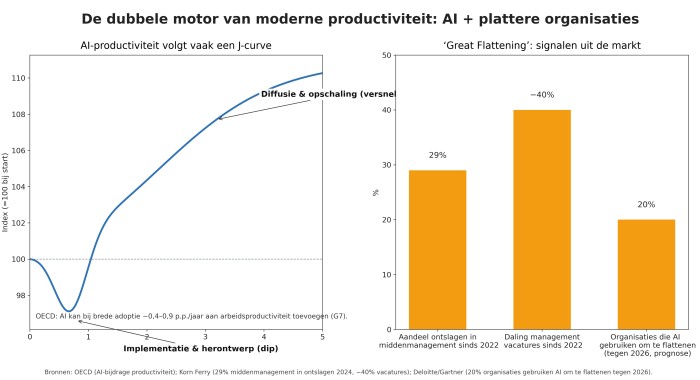
If you read carefully, you will see a common thread: middle management is structurally vulnerable. Analyses outline how “agentic AI” is taking over the reporting, coordination and control tasks that form the core of many middle management positions. As a result, the new redundancies feel different than before. It is less about temporary efficiency and more about a different view of what organisations can look like. The emphasis is mainly on flatter organisations: fewer layers, faster decisions, more direct data flows.
I am not surprised by this. We have seen a time when people management was elevated to a religion, with models, colour profiles and endless “engagement initiatives”. But companies are now discovering that a substantial part of that soft management layer adds less value than was assumed. We are seeing increasing evidence that HR is withdrawing from direct coaching and that this role is shifting to team leaders. HR managers are being given a more strategic role, focused on leadership styles and corporate cultures.
Figure 1
Leadership philosophy
My own leadership philosophy has always been simple: collaborate, “primus inter pares”, lead by example, and develop employees through the “mentor-mentee model”, with a focus on craftsmanship and personal responsibility. No extra layers of management and an organisation that is as flat as possible. I believe I see this story reflected in the latest rounds of redundancies. There is a global trend towards flatter organisations. Finally, “the great flattening”. Citigroup, for example, has already gone from 13 to 8 layers.
The mentor-mentee model has always made sense to me. A team leader who shares his or her experience and knowledge with his or her closest team members, “management by example”. Any interpersonal issues can be escalated to HRM, or possibly a confidential advisor. This also keeps the professional qualities of the team leader(s) closer to the team and prevents the Peter Principle – promoting professionals to a management level at which they are no longer effective.
The recent increase in productivity: AI or fewer management layers?
After years of grumbling about “stagnation”, we are finally seeing productivity growth again. In the US, labour productivity rose by 2.3% in 2024 (after +1.6% in 2023). This is no coincidence. Two movements are intertwined: AI that speeds up routine tasks and supports decision-making, and flatter organisations. The best empirical estimates place AI's structural contribution to (labour) productivity at approximately 0.4–0.9 percentage points per year once adoption becomes widespread, provided that companies redesign their structure accordingly.
For investors, this is not a simple AI-or-nothing story. The winners combine technology deployment with organisational design: fewer layers, greater span of control where possible, and coaching/mentoring close to the work. Look out for three signals in company disclosures: (1) ‘reducing layers / builder ratio / span of control’, (2) measurable workflow redesign (not just rolling out tools) and (3) skills and data investments that shorten the AI J-curve. Companies that do this well are potential stock market winners.
ASML is likely setting a good example with its recently announced reorganisation.
This article contains the personal opinion of Harry Geels