
Harry Geels: Three nuances regarding geopolitical insider trading

This column was originally written in Dutch. This is an English translation.
By Harry Geels
It is alleged that, over the past few weeks, $2.2 billion has been speculated on through three ‘perfectly timed’ oil trades by the ‘corrupt clan’ surrounding President Donald Trump. This kind of insider trading is reprehensible and a criminal offence. However, three points must be noted regarding such geopolitical insider trading.
In recent weeks, large short positions in oil (WTI) have been taken just ahead of major geopolitical news. On 23 March, a $500 million short position was taken, fifteen minutes before Trump announced he would delay the attacks on Iran. On 7 April, $950 million worth of short positions were taken, an hour before Trump announced the ceasefire between the US and Iran. And on 17 April, $760 million worth of short positions were taken, twenty minutes before Iran declared it would reopen the Strait of Hormuz.
Three seemingly perfectly timed short trades
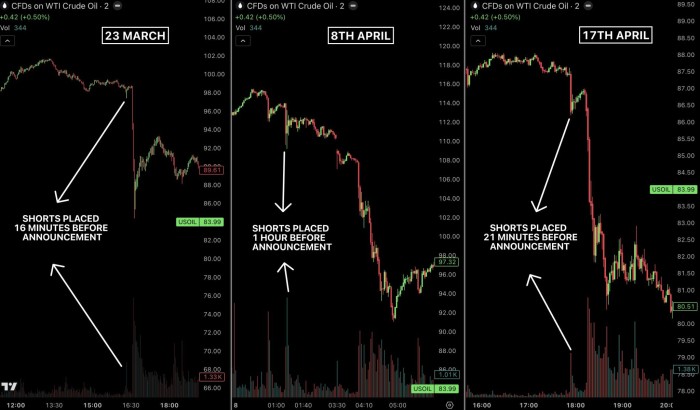
Source: Bull Theory/Charles-Henry Monchau
Insider trading is prohibited. This principle applies to all financial markets, although regulations and penalties vary by market and by country. In the past, regulators have identified more criminal offences in the trading of listed shares and bonds than in relation to geopolitical events on the currency and derivatives markets. This is because supervision is local, whilst currency and futures markets are global. The burden of proof – the precise source of information – is difficult to establish here. The timing alone does not constitute proof.
Side note 1: Speculation based on geopolitical inside information is nothing new
Not to exonerate Trump, far from it, but there has always been speculation surrounding major political events. In the weeks leading up to the 9/11 attacks, for example, a statistically significant number of additional put options on the airlines United Airlines (UAL) and American Airlines (AMR) were traded. The same applied to reinsurers and financial institutions with offices in the WTC, albeit with lower numbers of options.
In the weeks leading up to the market crash of 20 February 2020, several US senators, who had been part of closed-door briefings on potential impending COVID-19 lockdowns, sold large quantities of shares. This did not lead to convictions (though there were ‘successful’ criminal cases involving the pharmaceutical companies involved in vaccine development). Other unproven and well-known geopolitical transactions concerned the announcement of the Taper Tantrum (2013), the abandonment of the EUR/CHF peg (2015) and Brexit (2016).
Side note 2: ‘Cheating’ does not only take place on the stock markets
Stock markets are not the only place where money is made or lost. Sport and casino games are perhaps just as notorious. Is a poker player with the perfect poker face also cheating? Or the horse racing expert who knows which racehorses are ill or weak? Or the ‘savant’ who can memorise all the cards in blackjack? In the run-up to the war in Ukraine, various parties had already realised, via satellite imagery, that a large Russian military force was building up on the border with Ukraine.
When it comes to geopolitical information, we quickly find ourselves on the cusp of an ‘intelligent analysis’ of what is happening and ‘hard-nosed inside information’. That is what makes proving insider trading so difficult. There are even market participants, such as technical analysts, who closely track price and trading volumes. If, for example during the Iran war, they see that certain parties are building up short positions in oil, they can ‘piggyback’ on that. They do not trade with but on any inside information.
Side note 3: Inside information ≠ correct position
Then there is the question of whether inside information leads to the right trades. Financial markets are often volatile. Emotions come into play and various events often occur simultaneously. Financial markets rarely develop according to a perfect script. It is also about when you sell and whether you close out the position. In the media, we mainly see those transactions that have potentially yielded large profits. This makes us prone to selection or ‘salience bias’.
In conclusion
Many people would rather believe in a conspiracy than accept that markets sometimes move violently based on uncertainty, interpretation and daring. Perfectly timed trades feel like proof, but are often nothing more than visible outliers in a sea of failed attempts. That does not alter the fact that genuine insider trading is reprehensible and punishable by law. Perhaps the alleged design flaw – potential insider trading – lies not so much in the system, but in our tendency to attribute meaning to ‘success’ with hindsight.
This article contains a personal opinion by Harry Geels