The Wtp forces decisions regarding continuity, complexity, and communication
This report was originally written in Dutch. This is an English translation
“The fiduciary is going to disappear,” and “After the transition, that’s the moment to substantially increase the allocation to private markets.” These and other provocative statements fly back and forth during Financial Investigator’s pension seminar “Investing under the Wtp: lessons from the frontrunners—and what comes after the transition?”
By Esther Waal
|
CHAIR
Paul de Geus, Director, Supervisor, various pension funds
PARTICIPANTS PANEL 1
Rik Albrecht, Professional pension fund manager
Jeroen van Bezooijen, Executive Vice President, PIMCO
Justus van Halewijn, Delegated CIO, Columbia Threadneedle Investments
PARTICIPANTS PANEL 2
Hester Borrie, Head of Fiduciary Advisory Services, MN
Kees Koedijk, Professor of Banking and Finance, Utrecht University School of Economics, Co-founder of Finance Ideas
Mark Rosenberg, Asset management expert, various organisations
Ronald Verhagen, Director Investment Consultancy, AF Advisors
|
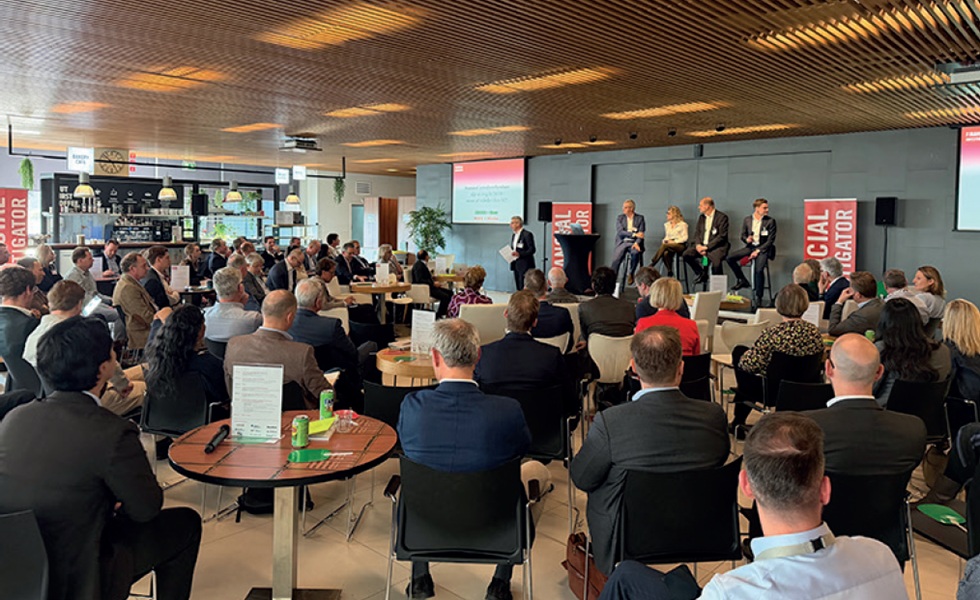
The auditorium at MN’s office is packed to capacity with professionals eager to learn more about optimizing investment policy under the Wtp and the outlook for the pension sector following the transition. Professional pension fund manager and regulator Paul de Geus serves as the day’s chair.
Return on Your Matching Portfolio
During the first panel discussion, he immediately challenges the panel and the audience with the question of whether the matching portfolio within the SPR framework should not only deliver a protected return but also generate additional returns through credits and mortgages. In the room, mostly green signs go up; only a few vote against.
Justus van Halewijn kicks things off and says that it all depends on the chosen approach. “We use a system where the size of the return portfolio is derived from the allocation to excess return. We equate these two, which results in the matching portfolio. Next, you assess what you need within that for your interest rate hedging, after which the LDI is determined. The remaining capacity can be filled with credits and mortgages.” According to him, this addition can yield a very attractive risk-return profile and add value to the excess return. “So, from your matching portfolio, you support your return portfolio.”
Rik Albrecht emphasizes that he is “not opposed to credits a priori.” Still, he finds the distinction between matching and return portfolios in the SPR somewhat artificial: “We simply have one collective portfolio.” According to him, the use of credits is often justified with the argument that you pay short-term interest on swaps and that you have to earn that somewhere. “Cash yields too little—about 15 basis points too low—and that would then be a reason to introduce a bit of spread risk.”
Van Halewijn acknowledges that, but emphasizes that it goes beyond mere cost compensation. “If your portfolio is relatively large and your interest rate hedging is visible, you can really also achieve extra returns.” Albrecht raises critical questions about this: “But does that actually translate into excess returns? Suppose you set up a spread portfolio that yields exactly those 15 basis points; that then flows to the older participants via the guaranteed return. As a younger participant, you only get the volatility of that spread, but not its average level. So you get a source of volatility, not of profitability.” According to him, you might as well “invest a few extra percentage points in stocks” to earn those 15 basis points. A participant in the audience notes that you’d be taking on more risk that way. Albrecht acknowledges this: “You’re going to get bitten by the dog or the cat. So which do you choose?” He emphasizes how difficult this makes participant communication.
Van Halewijn brings the discussion back to the core: it’s about conscious choices. “The most important thing is that the board makes well-considered choices based on analyses of the pros and cons of volatility in your mismatch result and your excess return.”
If your portfolio is relatively large and your interest rate hedging is well-structured, you can indeed still achieve extra returns.
Jeroen van Bezooijen looks at it from a broader perspective. Based on his years of experience with LDI, he believes that ultimately it’s all about a better return for the participants. If the total portfolio—including the matching portfolio—can contribute to a higher return, that’s “nothing but positive” in his view. He advocates for a broader approach than just Euro credits or Dutch government bonds. ‘When you think about the purpose of the protected return, it ultimately comes down to achieving a certain duration.’ He points out that this duration can be achieved in several ways: through government bonds, futures, or swaps. He continues: “Moreover, the relative value of these instruments varies over time. That offers scope for a more active approach.” For him, this is not just about interest rate hedging, but also about capitalizing on opportunities within cash management and credit markets. ‘You can generate extra returns through commercial paper or securitized debt.
In a system where participants see their returns monthly, investments must be understandable.
Time for private markets
The next proposition concerns illiquid investments under the Wtp: will there be more room to include them? The audience is divided. Slightly more red than green signs appear. Van Bezooijen outlines that the market has changed drastically over the past ten years: “More and more business activities are in private hands, on both the equity and debt sides. Corporate direct lending is now roughly the same size as the global high-yield market. ‘Anyone who ignores private markets is missing out on a substantial portion of the total investment universe,’ he states.
According to Van Bezooijen, the appeal of private markets is partly explained by structural developments since the financial crisis. ‘Banks have withdrawn from lending, creating room for private financiers. In that segment of the market, you can still achieve very attractive returns.’ He sees significant opportunities particularly within asset-based finance: attractive spreads with investment-grade credit quality. At the same time, he notes that Dutch pension funds invest relatively little in private debt compared to foreign institutional investors.
Van Halewijn qualifies this by pointing out that in recent years, a great deal of time has been spent on the transition to Wtp. ‘Some funds sometimes lament that they will hopefully have more time soon to look into these kinds of matters.’
De Geus notes that interest in private markets may also be rising due to the removal of the VEV restriction. Albrecht is critical of this. “The only ones who stand to benefit from the outset are the asset managers. They make a lot of money from it. For the participants, it’s a waiting game.” He points to a flood of advertising and publications about private markets. “I never see an ad for a passive MSCI World mandate.”
Albrecht states that he is not opposed to illiquid or innovative investments, but under the Wtp, they are not an obvious choice in his view. His main objection again lies with communication and transparency toward participants. “In a system where participants see their returns monthly, investments must be understandable.”
Those who ignore private markets are missing a substantial part of the total investment universe.
Van Halewijn points out that a pension fund wants to diversify. “You don’t want all your money in stocks.” In his view, illiquid investments can add value, but they require a lot of time and governance resources from a board. “Ultimately, the board must determine whether they truly add value for the participant.”
Geopolitical considerations
The final discussion of the first panel revolves around allocation to emerging markets and the U.S., and specifically the dominance of the U.S. in portfolios. Is now a good time to diversify more by investing more in emerging markets and reducing the U.S. allocation? The audience is almost unanimously against it. Only a handful hold up a green sign. Van Halewijn points out that such adjustments are not dependent on the WTP: “If you currently have reasons to think, ‘I have too high a concentration risk toward the US,’ then you can adjust that right now.” ESG considerations can play a role in this, he adds. “But,” he warns, “with emerging market equities, you have to realize that a quarter of a passive EM allocation consists of China, over 20% of Taiwan, and about 18% of South Korea. That means two-thirds of your portfolio is still in relatively developed markets.”
Albrecht notes that the debate over concentration risks is often held in boardrooms, but that the market does not view concentration risk as problematic, given the low implied volatility. He further observes that discussions about the U.S. are often driven by political preferences, for example regarding Trump: “If, as a pension fund, you express a political opinion using participants’ money, ultimately the participant pays the price.”
Making distinctions is important. A unique portfolio with unique insights gives a pension fund its raison d’être.
Van Bezooijen qualifies that. He points out that it is not about Trump. “The geopolitical landscape is undergoing massive changes toward deglobalization. This is highly relevant for investment decisions. To not take that into account when determining your investment strategy is, in my view, a bit naive.” He also points out that EM debt is an attractive alternative. ‘You’re less affected by the concentration risks mentioned earlier, and many emerging markets have, compared to developed countries, managed to keep inflation better under control in recent years and pursued a more prudent fiscal policy.’
The first panel demonstrates that the choices facing pension funds are complex. It is not just about returns and risk, but also about governance, communication, and the social context.
Consolidation Drive
The second panel also kicks off with a provocative question: how many pension funds will still exist in 2030? More or fewer than fifty? The prevailing sentiment in the room is that there will be more than fifty, but the panelists paint a different picture. Ronald Verhagen is the first to respond and emphasizes that he is not advocating for fewer pension funds.
“I advocate for a diverse sector with diverse investment portfolios. What I do advocate for is sound investment policy, cost efficiency, professional organizations, good governance, and well-thought-out sustainability policies. If we set the bar high in all these areas, we can’t really conclude anything other than that further consolidation lies ahead.”
Verhagen points to developments over the past two decades: around 2006, the Netherlands still had about 450 pension funds; now there are roughly 150. According to him, a further decline to approximately fifty funds is inevitable, though this will not happen until around 2035 or 2040. “Funds are currently primarily focused on the transition to the new system, but sooner or later the question will arise: ‘Are my members better off with an APF, with another pension fund, or with an insurer?’ Looking even further into the future, he envisions a sector emerging that resembles the banking and insurance landscape: a few major players, supplemented by smaller funds with a clearly distinctive profile. “Differentiation is important. A unique portfolio with unique insights gives a pension fund its raison d’être,” he states.
You’ll see that smaller players will consolidate using a fiduciary model, while larger players will instead provide customized solutions to other large players.
Mark Rosenberg shares the view that the bar is being raised higher and higher. “Professionalism will increase. DNB will also demand that.” He puts this into perspective by pointing to the current scale of funds: “The current number 50 has assets of about 3.5 billion. That’s not very substantial for a pension fund. Number 25 is around 10 billion, which isn’t very large either. It’s only around position 12 that you reach funds with more than 20 billion.” Although he considers 2030 too early to be a tipping point, he does expect an acceleration in consolidation. Ultimately, he sees a structure emerging that resembles that of health insurers, “with a more efficient and professional way of managing, as is already being demanded of banks and insurers.”
The Future of the Fiduciary Landscape
De Geus then puts forward a proposition that immediately stirs the audience: the fiduciary is going to disappear. “I see mostly red, meaning disagreement, but also a few green lights. That’s quite interesting,” De Geus notes. He gives the floor to Rosenberg, who points out that, although many pension funds use a fiduciary manager, a fiduciary model is not a necessity in his view. “There are countless funds that don’t have a fiduciary.” He also points to examples from abroad. “In the United Kingdom and the United States, fiduciary management is primarily used by smaller funds, while in countries with extensive consolidation, such as Canada, Australia, and Scandinavia, large funds have instead built strong internal organizations.” He notes that APG and PGGM have now parted ways with their fiduciary clients and work exclusively for their own clients. “Large players want to regain ownership of strategic activities, such as strategic advisory services, ALM advisory, portfolio construction, as well as management reporting and investment administration.” According to Rosenberg, the development of technology and AI also makes this easier. “Information flows can be managed much more easily and thus organized internally as well.”
Value is at least as important as costs. Look at private assets. They are expensive, and yet there is a lot of interest in them.
Hester Borrie also sees the consolidation trend as inevitable, but expects differentiation. “You’ll see smaller players consolidating under a fiduciary model, as is already happening with the APF, while larger players will instead provide customized solutions to other large players who also have—and want—the capacity for customization.” According to her, a divide is emerging between standardization and customization, making things particularly complicated for parties that try to do both. She agrees with Rosenberg that technology offers more opportunities. ‘But,’ she says, ‘my experience in fiduciary services is that outsourcing tasks also brings all sorts of challenges. As a fiduciary, you still need to be in control. Outsourcing always sounds very appealing, but as an organization, you first need to have everything in order yourself.’
New role for the pension participant
The conversation then turns to the role of participants under the Wtp. Two-thirds of the audience believe that role needs to be redefined. Kees Koedijk calls it a massive undertaking: “Now that participants are getting their own accounts, pension funds will communicate with them much more directly. The sector, the regulator, and indeed society as a whole are vastly underestimating what this will mean.” According to him, clear instructions must be issued quickly by DNB and the AFM. “We’re about to enter uncharted territory, and it’s all too easy for a regulator to say afterward that the information provided wasn’t adequate.”
In response to a question from the audience about how to deal with disinterest from participants, Koedijk states that the current lack of interest says nothing about the future. Koedijk: “We’re talking here about the largest asset the average Dutch person owns. The question is how robust the new pension system is if, for example, there are three consecutive periods of market losses. We must not hide behind the fact that people showed no interest in the past. People had no say whatsoever in the old system. Now a much greater share of the responsibility lies with them.’ Koedijk calls for learning from the experiences of other countries, such as the United Kingdom and Scandinavia. ‘Mobilize all the experience and knowledge they have, and that science can provide.’
Borrie adds to this with another observation. She expects that transparency and comparability between funds will increase engagement. At the same time, she notes that younger generations are already more engaged with their financial future: “People between the ages of 30 and 35 are already much more accustomed to individual accounts—think of the self-employed—and pay attention not only to returns and costs, but also to service and identity, such as sustainability and engagement with the sector in which someone works.”
Fees versus value
Finally, the question arises as to whether the focus on costs will influence investment policy. The audience largely disagrees. Verhagen concurs: “I believe people are rational enough to know that, ultimately, it’s about the net return. If you’re convinced that you need to incur slightly higher costs but can also generate a higher return as a result, then those higher costs are justified.” Koedijk, however, expects costs to play a more prominent role in communications with participants, partly inspired by examples from Scandinavia. Rosenberg qualifies this: “Value is at least as important. Look at private assets. They’re expensive, and yet there’s a lot of interest in them.” According to him, it’s mainly about a compelling narrative and a well-thought-out approach. Borrie adds that you can make different propositions: “Sometimes you can choose the cheapest option, and sometimes you can focus more on value.” Verhagen concludes with a clear call to action: “Don’t just go for a cheap portfolio that’s easy to explain. Go for the difficult narrative if it offers more value.”
Mobilize all the experience and knowledge gained in the United Kingdom and Scandinavia, as well as what science can provide.
In doing so, he underscores that choices can no longer be viewed in isolation, as was also evident in the first panel discussion.
Both panel discussions show that investment policy, organizational structure, and communication with participants are increasingly intertwined. Pursuing higher returns through more complex investments requires stronger governance and clear explanations to participants.
The Wtp thus marks not only a new pension system but also a new phase in which pension funds must make more explicit choices: between scale or specialization, simplicity or complexity, and above all, a consistent narrative for their participants.
|
SUMMARY Pension funds need to consider whether the matching portfolio should provide only protection or also generate additional returns. Investing in private markets offers opportunities, but also raises questions about costs, transparency, and accountability. Geopolitics and diversification remain relevant, but the timing is independent of the Wtp. The pension sector is moving toward consolidation and possibly a different fiduciary model. The participant will play a greater role. Communication will be crucial. |