
Aqua-Spark: Sustainable aquaculture is the next investment frontier

Aquaculture is rapidly transforming: technological development, climate pressure, global diversification, and regulatory change are driving the creation of a scalable and increasingly investable protein system with relevance for institutional portfolios.
By Boris van Troost, ESG & Impact Officer, Aqua-Spark
Aquaculture has expanded into a major global protein industry generating more than $ 300 billion in annual farm-gate value, with additional value created through processing, logistics, and distribution of at least $ 150 billion. For more than forty years, its growth has consistently outpaced all major terrestrial livestock categories. This momentum is structural, not cyclical, driven by long-term shifts in demographics, food demand, and the natural limits of wild-capture fisheries. With more than one-third of assessed wild stocks harvested at biologically unsustainable levels and wild output essentially unchanged since the early 1990s, any future increase in seafood consumption must come from scalable production systems capable of meeting global demand.
The industry is also changing rapidly, and it must change to continue to scale. Modern technologies are transforming productivity, economics, traceability, and risk management. Advanced sensing, automated feeding, real-time farm management platforms, improved genetics, novel health tools, and new low-impact feed ingredients were either unavailable or commercially immature only a few years ago. Their adoption is accelerating and increasingly underpins performance improvements across regions and species. These innovations scale horizontally across the industry and are reshaping the investment profile of aquaculture, turning it from a traditional resource sector into a modern, technologyenabled global growth market.
Climate dynamics reinforce this trajectory. The ocean absorbs a substantial share of human-generated carbon dioxide and most of the excess heat produced by greenhouse gas emissions. These buffering functions are weakening as warming and acidification progress, reducing the resilience of marine ecosystems. Heavy fishing pressure compounds the strain by disrupting food webs and ecological balance. Reducing extraction from the ocean is therefore both an environmental priority and a climate-risk mitigation imperative.
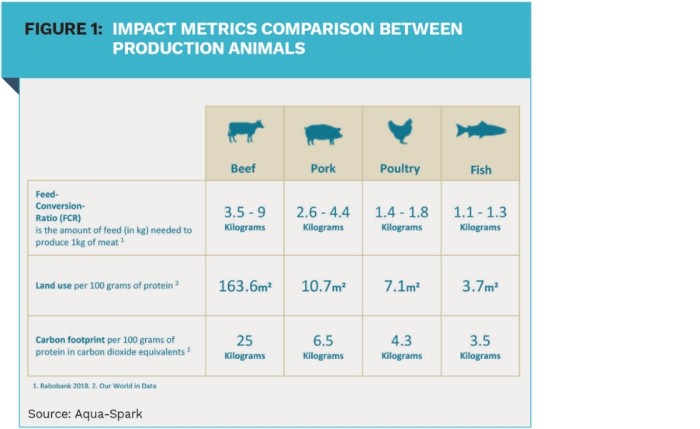
From an investment perspective, aquaculture’s biological and carbonefficiency advantages translate directly into economic strengths. Fish require less energy to convert feed into edible protein because they are cold-blooded and live in a buoyant environment, resulting in favourable feed conversion ratios and structurally lower operating costs. Beef typically requires eight kilograms of feed to produce one kilogram of live-weight gain; in fish that ratio can be smaller than one to one. The carbon footprint of farmed fish is also substantially lower than that of pork, which roughly has double the emissions per unit of protein, or beef, which can emit seven times more.
As global policy frame- works and private-sector commitments converge around decarbonisation, these characteristics are increasingly shaping procurement decisions, regulatory approaches, and capital allocation.
Beyond its environmental alignment, aquaculture is far more diverse than the conventional focus on salmon and shrimp implies. The global industry includes seaweed, bivalves such as mussels and oysters, highvalue species like urchin and abalone, and a wide range of warm-water finfish. Each carries its own biological profile, capital intensity, production cycle, and end-market structure.
Seaweed and bivalves, for example, typically involve lower biological risk and lower input costs, while warm-water finfish offer rapid growth cycles suited to expanding regional demand. This diversity enhances the resilience of the global sector and provides investors with multiple avenues for exposure; each aligned with different risk levels and return expectations. Aquaculture is also a globally distributed industry with multiple regional growth engines. Norway and Chile continue to lead in cold-water species, supported by established infrastructure, regulatory oversight, and export markets. Southeast Asia anchors cost-competitive production across a wide variety of species. The Middle East is rapidly scaling land-based recirculating systems (RAS) as part of national food-security agendas. Europe and the United States are becoming hubs for aquaculture technology, feed innovation, and health solutions.
Together, these regions form a global network in which genetics, feeds, equipment, data systems, and species circulate across borders. As the industry grows more interconnected, the need for transparent, traceable supply chains increases, accelerating investment in digital infrastructure.
ESG and regulatory develop- ments are reinforcing these trends. Institutional sustainability mandates increasingly direct capital toward lower-impact, climateresilient systems and transparent supply chains. Many of these objectives naturally align with aquaculture’s lower land use, and carbon footprint relative to terrestrial livestock.
Regulatory frameworks are tightening in leading markets, including stricter limits on antibiotic use, requirements for environmental monitoring, and expanded certification schemes. These rules are pushing farms and suppliers towards more advanced operating models and are supporting growth in the enabling technologies that facilitate compliance and performance improvement. In markets such as Norway, regulatory pressure for better biological outcomes is accelerating the adoption of new monitoring, genetics, and health tools.
A clear and transparent view of risk remains essential. Aquaculture carries recognised challenges including disease, extreme weather, and price volatility. Historically, some subsectors have carried elevated risks. These risks are real but increasingly manageable.
Disease risk is being mitigated through genetics, vaccines, and data-driven biosecurity systems. Weather-related disruptions can be reduced through geographic diversification, resilient farm infrastructure, and land-based production. Exposure to price swings can be moderated by focusing on species with stable end markets or by investing in enabling technologies that serve multiple species and geographies. A diversified, value chain-oriented investment approach enables exposure to industry growth while reducing dependence on any single biological or market factor.
Financial performance varies across the value chain, but clear patterns are emerging. Technology, health, genetics, and specialised feed ingredients show improving margins and defensible market positions. Time to commercialisation is shortening as the industry matures and as technology adoption accelerates. Acquisition activity in aquaculture technology has begun to increase, creating clearer exit pathways than existed a decade ago. Historically, early-stage ventures required seven years or more to mature, but growing demand, clearer regulatory environments, and greater interest from corporate buyers are helping shorten development cycles. Currently, well-managed, scalable projects have IRRs in the 20-30% range. These developments point towards an increasingly liquid and established investment environment.
Despite this progress, institutional participation remains limited relative to the importance of the sector. Yet conditions for broader adoption are converging quickly. Rapid technological advances, strong demand for sustainable protein, tightening ESG requirements, and improving financial track records are all accelerating capital inflows.
The transition from an early-stage, underinstitutionalised market to a mainstream asset class is already underway. The window between today’s conditions and widespread institutional recognition is narrowing. Investors who wait risk entering a more competitive landscape, at higher valuations and with reduced access to differentiated opportunities.
The past decade of innovation and early impact-oriented capital has laid the foundation for this transition, the coming decade will determine who benefits from it.
|
SUMMARY Aquaculture is becoming a modern, technologyenabled global protein industry, improving productivity, transparency, and risk management. Climate pressures and weakening ocean resilience increase the need for scalable, low-impact production systems. Strong biological and carbon efficiency make aquaculture economically and environmentally competitive. Species and regional diversity create resilience and broaden opportunity. ESG and regulation are accelerating adoption. Risks exist but are increasingly manageable. Institutional participation remains limited, yet the window for advantage is narrowing. |
Read the article in the digital magazine