
Roundtable 'Beyond Bricks'
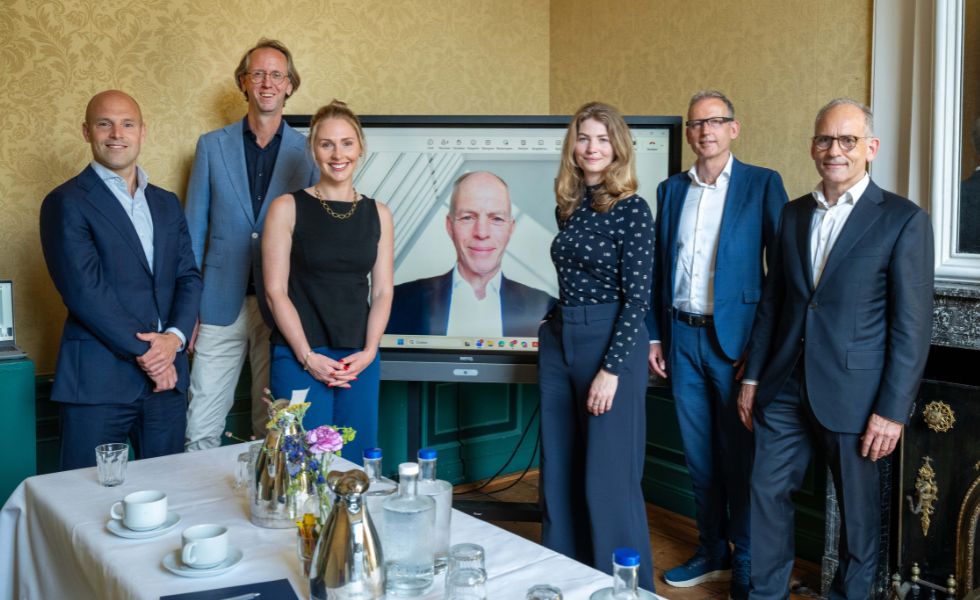
This report was originally written in Dutch. This is an English translation.
Investment in social property is increasingly driven by the desire not only to achieve a financial return, but also to create social value. The two need not be mutually exclusive and can go hand in hand very well.
By Hans Amesz
|
CHAIR: Andrea Palmer, CRREM
PARTICIPANTS: Norbert Bol, Building Values Jan-Willem Dijkhuis, Lymos Yno van Haaster, Columbia Threadneedle Investments Peter Hobbs, bfinance Iris Kampers, Savills Nederland Daan Tettero, Achmea Real Estate |
How can property investors, in the current market climate, achieve both attractive, risk-adjusted returns and create tangible social value?
Jan-Willem Dijkhuis: ‘The demand for social value has increased significantly in recent years. It is not that investors are prepared to lower their financial return requirements, but they are increasingly trying to achieve financial returns and social value simultaneously. In many cases, the latter is fairly straightforward in property: creating a communal space, for example, is the first step towards greater social value. Creating financial returns and social value generally starts with a strategic plan. You have to ask yourself what you are striving for, what your goal is, and whether that is financial or social.’
Iris Kampers: ‘I’m inclined to say that the path to economic value is paved with social value, because factors such as well-being, good air quality and green spaces help you reduce CO₂ emissions whilst simultaneously adding social value.’
Norbert Bol: ‘In principle, societal and social values play a role at every stage of the investment process, just like environmental and financial values. In practice, property investors recognise that there is no single standard approach, as every location is different in terms of physical and social infrastructure. It is particularly important to explore with the relevant stakeholders what is possible in order to arrive at the best solution.’
Peter Hobbs: ‘There’s one thing we mustn’t forget: one of the main reasons for investing in property is to diversify the portfolio, and I believe that social property offers an additional layer of diversification. It acts as a different economic driver and delivers added value in terms of investment risk management and investment performance. Social property has also become more important because investors need to be even more aware of the political pressure on investment management and the desire to see a better alignment between performance and social benefit. In that respect, it almost acts as a risk-mitigating factor. Exposure to social factors – factors from the public sector – is a clear source of risk diversification.’
Yno van Haaster: ‘As a result of growing awareness of local climate and social issues, residential property accounts for a significant proportion of the property portfolio. It is now recognised that financial returns and social returns go hand in hand, with social considerations taking on an increasingly central role. There is a belief that social property appreciates in value and is particularly resilient in the longer term. In a market such as the Netherlands, social relevance is also part of the licence to operate. ‘If you invest in segments where there is a clear social need, such as affordable housing or housing suitable for care, this increases the likelihood of local support and reduces your policy and reputational risks.’
Daan Tettero: ‘Investing in social property is driven by social pressure – and perhaps also political pressure – to invest not only in bricks and mortar, but also in the social aspect. However, the two are not mutually exclusive. Our philosophy is that a sound ESG policy actually ensures a better risk-return ratio.’
Dijkhuis: ‘Shopping centres attract people, who also go there to meet others. In my own shopping centre, for example, you see lots of bakeries with seating areas. Attracting people is certainly the social value of the retail sector.’
Bol: ‘In addition, good property and retail managers involve people from the local community and offer them opportunities to learn and gain practical work experience, both young people and those who are further from the labour market. Seen in this light, there is a dual social value.’
Hobbs: ‘Social impact is very different from climate impact. With climate impact, it doesn’t matter where you take action, because we all live in one world. Social impact is primarily about local impact within a country or a region. There is a great need for local investment, and this is often associated with urban regeneration, which is broader than social housing. It’s about revitalisation, the retail sector and job creation.’
Bol: ‘In the United States, there is the phenomenon of “Community Investors”. These are commercial investment institutions set up specifically to invest in specific local areas and, for that reason, forge strong links with the local community and its entrepreneurial spirit. In the Netherlands, this is less common amongst commercial investors. In the US, there is more scope for entrepreneurship, which enables Community Investors to add value in areas, and the government also provides the scope for this. We could learn something from this in the Netherlands.’
If creating social value in the property sector consistently comes at the expense of financial returns, should investors still regard this as an investment, or does it in fact become a form of philanthropy?
Dijkhuis: ‘The first thing you must do as a pension fund is to look after your members. The secondary objective is to take the social values of your investments into account. You can do both, because I don’t think you have to choose between a good financial return and social value: you can combine them without sacrificing the financial return. But when, as a pension fund, you settle for a lower return because you want to make an impact, that is philanthropy. A good example is green property bonds. These carry a lower interest rate than ordinary bonds, whilst the risk profile of the property fund remains unchanged.’
Hobbs: ‘Pension funds must generate a financial return for their members. If they can also achieve an impact alongside this, that’s brilliant. Where we do see some compromises, however, is with endowment funds, charitable foundations and certain asset managers. A fascinating trend is emerging among endowment funds, namely that they are channelling fewer of their capital returns to charitable causes and using them to generate impact instead. As for the question of the risk involved or whether the return profile is changing, I think we need to consider a spectrum: a spectrum of impact, ranging from very high to lower, and a spectrum of financial returns. I don’t think you need to sacrifice financial returns if you’re also achieving impact across that entire spectrum.’
Bol: ‘Good investors with a long-term vision understand how to create value. These investors therefore often have a lower risk profile because of the broad support they enjoy. They sometimes offer rent discounts to entrepreneurial tenants who, in return, undertake social and community activities. These costs deliver significant added value for all stakeholders.’
Kampers: ‘We’ve seen before, with specific “flagship” investments, that people are prepared to adapt their business case from purely short-term financial returns to long-term financial returns or social value. In such cases, there is clear value in moving away from the traditional business case, because you know this will pay dividends in other ways within the portfolio. There’s always something you get back.’
The path to economic value is paved with social value
Tettero: ‘We have been focusing more on social returns for some time now. We want to continue to make an impact, whilst achieving more or less the same financial return. I think the long-term risk is actually lower if people are happier, if they have some money left over to spend on affordable housing, if they have a flat with low energy consumption. These factors contribute to creating social impact and ultimately that will result in lower risk.’
Van Haaster: ‘I, too, do not see it as a black-and-white approach – that is, either philanthropy or a focus on financial returns. I actually find the dichotomy between investment and philanthropy too simplistic. There is a continuum. At one end is purely financial return; at the other, purely social impact. Many real estate impact strategies lie somewhere in the middle, and the question then is what combination of financial return and social outcome is appropriate for the investor. For an investor, the lower risk profile of social investments is a significant advantage. If you are aiming for social returns, property is highly suitable compared to other asset classes. I can point, for example, to affordable housing, where vacancy rates are structurally lower than in the mainstream market. In many parts of the mainstream housing market, the remaining vacancy rate actually consists almost exclusively of frictional vacancy between tenants. A lower turnover rate for affordable housing translates into lower turnover costs and a more favourable risk profile. It is precisely for this reason that you can create social value without necessarily sacrificing financial returns. If offices are well equipped with facilities, tenants are willing to pay a premium. I believe that having a social focus does not come at the expense of financial returns.’
Dijkhuis: ‘If a low risk profile is a choice when it comes to social investments, that’s fine. But a lower risk profile means a lower return. You need to be aware of that. Sometimes, of course, the challenge is to achieve a higher return, because you’re there to beat the benchmark. So you need to strike a balance in your portfolio between a low return with low risk and a higher return with higher risk, and work out how to achieve that. That is the asset manager’s job.’
Bol: ‘I don’t agree that lower risk means a lower return. If you manage your affairs poorly, you’ll have to put in a lot of work, which ultimately results in a lower return despite higher risk. If we manage and understand our social values properly, we have a lower risk. Ultimately, you achieve a decent return with a lower risk profile. I believe this is demonstrated globally by investment examples. Property managed from a community perspective, with an emphasis on social value, generates the best risk-adjusted returns and therefore outperforms the benchmark.’
Dijkhuis: ‘From an economic theory perspective, low risk means low returns.’
Bol: ‘Better risk management leads to better returns. That is one of the reasons why professional managers outperform the benchmark.’
Kampers: ‘If you accept that lower risk means lower returns, wouldn’t that be all the more reason not to classify it as philanthropy? Because in that case, the market must do its job and motivate us to create a better business case. We need to think more carefully about this and quantify it better. We need to develop more systems for this and ensure that we have first-hand knowledge of what we’re dealing with and what we’re aiming for. By classifying it as philanthropy, you undermine the motivation you would otherwise have to perform better.’
Hobbs: ‘It’s about how all this contributes to improving property management and how you measure it. In the United States, some providers of affordable housing use metrics such as voter engagement, educational attainment or children’s swimming ability. If you focus on those kinds of metrics, you build a resilient community and a better place to live. That yields economic benefits through higher occupancy rates, lower maintenance costs, and so on.’
Van Haaster: ‘The reason you can achieve lower risk in property markets without sacrificing financial returns is that they are inefficient and opaque.’
Which aspect of property development and property management is crucial for creating social value in the sectors of housing for older people, care property and student accommodation?
Bol: ‘It’s often a matter of clever combinations and an understanding of how to combine things. In some German cities, for example, you see the success of combining student accommodation with homes for the elderly or for people with severe disabilities. In practice, these fit together very well and deliver added value. You have to try to make the various elements work together, so that the whole is not too monofunctional, because monofunctionality is, of course, disastrous for diversification and resilience.’
Tettero: ‘What is crucial across all these segments is the opportunity for people to meet one another, for example in a garden or a green space, or across the street where there is a nice restaurant or café. At one of our properties in Amsterdam, the communal space has fostered such a close-knit community that for some activities we have to move to a larger venue elsewhere. It’s about having the space for people to meet and then adapting it to the community in that particular area.’
Social property offers an additional layer of diversification and delivers added value in terms of investment risk management and investment performance
Hobbs: ‘An important question is: what does “impact” actually mean? For some, it is about increasing the provision of healthcare or housing for the elderly. At the other end of the spectrum, there is a strong focus on toddlers and young children to support their life chances. Incidentally, many of these activities, such as nurseries and housing for the elderly, are highly operational in nature and can involve significant reputational risks. These risks must therefore be carefully managed. Some people think: well, whatever form of elderly care or healthcare you provide – even if it is for-profit – it increases supply, thereby reducing costs. Others say it should be much more focused on the most vulnerable groups in society. The answer to the question of what the impact is for a specific investor varies enormously.’
Bol: ‘You need a certain amount of profit to be future-proof. It is even accepted in Dutch politics that there are profit-driven activities in the care sector, childcare, or in any other form of care. The market can often respond more flexibly to needs than regulation can.’
Tettero: ‘It seems that profit-driven institutions usually offer a higher standard of care than non-profit organisations, but that is not universally the case. Where there are excessive profits, such as with luxury healthcare villas, many investors walk away, arguing that these are not impact investments. That applies to us as well. We invest on behalf of our clients in private healthcare, but specifically in the affordable segment.’
Dijkhuis: ‘I think the vast majority of initiatives in the property sector revolve around social value, because I cannot imagine developing a property project without social value.’
Kampers: ‘I think it’s great that we’re now at a stage where everyone at this table is challenging themselves to create more impact. However, that requires a strategy: you have to determine for whom and how you invest and create impact. The high-profile investments that make the headlines have a strategy that looks beyond the ‘standard user’ of that type of property. All too often, we focus solely on the people who work or live in a building. We give less thought to the people who do not use the building themselves, but who are nonetheless affected by it. Think of the residents living near a logistics depot. Another group of people we should think about more often is the group that passes the building via public routes, for example on their way to their own work or home. In the case of offices, for instance, you could also set aside part of the building for people who happen to pass by, with a green space they can walk through. People living near such an office experience a positive effect when part of the office is converted into a public space. Think of a coffee bar.’
The long-term risk is actually lower if people are happier in their homes, consume less energy and can afford to live there
Van Haaster: ‘The community is crucial. These days, we see that property projects are becoming part of the local environment and landscape, so that it is not only people in the office who come together and form a community, but also people who live near the office and come there, for example, to get their coffee.’
Kampers: ‘This also ties in with the concept of the “fifty-minute city”, which means that you need to have various functions and amenities within a specific area to create a sense of community. Take the Zuidas in Amsterdam, where there used to be nothing but offices. It was only when more residential developments were built that it became safer to work there: the presence of more people in the evenings had a huge impact on social safety.’
Bol: ‘The Leiden Bio Science Park is another good example. It was a successful science park because it had been managed as such for many years, but it wasn’t part of the city. Now that housing is also being added, it is not only a successful science park but also a more vibrant part of the city, which is brilliant.’
Dijkhuis: ‘At the same time, the same local authority has decided that it is not permitted to convert a vacant office building in the same park into residential accommodation.’
Hobbs: ‘As far as affordable housing is concerned, there has been a major shift: every new housing development must now include a certain number of affordable homes. And that’s a good thing. We’re seeing more growth in the supply of affordable housing, which leads to a more diverse tenant mix. But it does raise questions about financial viability, because if there are too many affordable homes, the project becomes unprofitable and you slow down the development of new homes. This is a difficult balance to strike, one that planners and regulators must find together with the private sector.
Van Haaster: ‘I believe you need to adopt a broader vision: you want a community where people can also take the next step up the housing ladder, so that they become connected to the local community and keep the neighbourhood in a good or even better state.’
I think retail currently offers a very good return on investment. And through retail, you can add a great deal of social value.
Hobbs: ‘One aspect of affordable housing – and probably the one with the greatest impact – is shelters for the homeless to help them reintegrate into society, or shelters for refugees. However, in the current, more polarised climate, there is a great deal of resistance to this. It is now becoming much more difficult to include that segment of affordable housing as part of your impact strategy, due to local opposition and the reputational issues that come with it.’
Which property segments currently offer the most attractive combination of financial resilience and positive social impact?
Tettero: ‘First and foremost, housing for the elderly – that’s absolutely crucial. It’s one of the most important sectors in which investors are currently keen to invest. Next comes student accommodation. That’s really the next market poised to make a bigger impact. Investing in good locations for student accommodation is also of great importance for the next generation. Next comes affordable housing; that’s also a good market. Finally, in the Netherlands we have a lot of older housing stock with poor energy ratings. It makes sense to invest in this and bring the older properties up to the highest standards of sustainability.’
Dijkhuis: ‘I think retail currently offers very good returns. And through retail, you can add a great deal of social value. The combination of high yields and social value currently makes retail one of the best property sectors in which to invest. What’s more, rents have shown healthy growth in recent years. There is now more supply than demand from investors, which means prices are favourable and we are at a good point in the cycle. Investing in retail is admittedly slightly riskier than investing in, for example, the mid-market rental sector. But it also offers the potential for additional returns by developing housing for the elderly above a shopping centre. This allows you to achieve both a social return and a good financial return.’
Van Haaster: ‘I am convinced that the opportunities in the broader housing market are the most attractive, as this is the part of the property market where people spend the majority of their time. Student accommodation can be valuable, but mainly when the properties are also suitable for first-time buyers. This creates a broader base of demand and ensures the property remains more versatile for different target groups. Traditional student accommodation often offers few alternative uses, whilst the number of students is no longer growing rapidly. That is why I see greater structural potential in affordable housing and housing for the elderly. It is precisely these segments that address major social needs and stimulate mobility in the housing market.’
Hobbs: ‘Across all forms of affordable housing, there is a massive shortfall in supply and huge demand, which puts pressure on the cost of living. I believe that in Europe, 80 million people spend 40 per cent of their income on housing. By 2030, 25 per cent of the European population will be over sixty years of age, which, in terms of housing for the elderly, will result in a massive shortfall in supply. The quality of housing for the elderly is poor, and institutional involvement is needed to improve the social infrastructure. This requires local investment in areas such as urban regeneration and the retail sector.’
Bol: ‘Local and area-focused investment also requires property managers who can act as the genuine links with local communities, whether or not with the support of community apps and the investor. To create social, societal and financial value, you need effective collaboration.’
Property managed from a community perspective generates the best risk-adjusted returns
Dijkhuis: ‘In many cases, the fund manager isn’t particularly involved at a local level. The property manager is, in fact, the one who has a connection with the local authority or the housing association. Most investors have a strategy for where they want to invest. They have a plan, and that, I think, is more important than a local presence.’
Bol: ‘A number of fund managers have decided to set up a new property management organisation, focused specifically on social value, because the usual property managers were unable to cope with the task.’
Private property is one of the few asset classes with a direct, measurable link between capital deployed and social outcomes achieved: more capital often means more homes, more beds, more accommodation. Yet most institutional investors stick to conservative allocations and low leverage. What is needed to bridge that gap?
Van Haaster: ‘One of the challenges facing the housing market as a whole is, ultimately, a shortage of capital. At the same time, I think the discussion often focuses too much on how much capital is available and too little on how we measure risk. If institutional investors have sufficient confidence in the risk-return ratio, more capital can be freed up for housing construction and other social challenges. It helps that property is one of the few asset classes where the relationship between capital deployed and social outcomes is relatively immediately apparent. More investment simply means more living space, more care-appropriate homes or more affordable housing. What I believe is needed to bridge that gap is greater intentionality and better measurability. Investors must not only be able to see how many homes are being built, but also what social outcomes are being achieved as a result. Once social objectives are linked to clear KPIs and a robust risk framework, it becomes much easier to justify larger allocations. The discussion then shifts from ‘taking on more risk’ to ‘deploying capital more efficiently’, allowing financial returns and social impact to reinforce each other rather than compete with one another.’
Hobbs: ‘Part of the problem is that these are relatively new asset classes for investors. There aren’t many products available, and they’re difficult to access. The question is whether you want to invest in a relatively new product – such as housing for the elderly or affordable housing – that has not yet reached scale, creating a risk of volatility as these still-immature markets grow in size and depth. We are at a stage where, across Europe, there are insufficient products in the housing market that have achieved scale. There are a few open-ended Article 9 products that have achieved scale, particularly in the affordable housing sector. An important step could be to make these more relevant. We must ensure that they play a more prominent role within the larger, diversified open-ended products, so that we can then bring capital into the sector on a large scale.’
Tettero: ‘We have gained experience in this area and are now scaling it up, making it part of the standard portfolio. It helps to highlight successful projects which, in addition to financial returns, also make a positive impact. That will help to convince investors to invest in these strategies with a social impact.’
Dijkhuis: ‘The investment climate for property, particularly in the Netherlands, has deteriorated in recent years. If you want to compete with other asset classes, it would be good to have a better investment climate, because then investors will see better returns and say: property is a good option. Furthermore, more needs to be done in the area of education within training programmes for investors, such as the CFA, and in providing information about property.’
What role does reputational risk play for pension funds when investing in property?
Tettero: ‘Reputational risk is certainly a factor, but property also offers opportunities to demonstrate the impact you make as a pension fund. If I have a problem with one of my property assets, the first thing I do is inform the communications team. On the other hand, we do the same with the successes we achieve in terms of the impact we make. As well as managing the risks associated with your assets, it’s also about good communication.’
Investors must not only be able to see how many homes are being built, but also what social outcomes are being achieved as a result
Van Haaster: ‘Reputational risk certainly plays a role in property portfolios. If you’re a responsible property investor, you know what you own and you work with the manager to control that risk, for example by not raising rents aggressively and by remaining engaged with the local community as a logistics operator. Reputation is not just about avoiding negative publicity. In a market such as the Netherlands, it also largely determines your social and political support base. Property investors need a licence to operate: if your investments align with social priorities, this increases the likelihood of cooperation with public authorities, local support and a more stable policy environment.’
Kampers: ‘Legislation in the property sector is changing rapidly. The European Commission has introduced a great deal of new sustainability and benchmarking regulations, with property receiving significant attention due to its major environmental impact. As a result, the playing field is constantly shifting, which creates uncertainty for investors. Advisers must therefore help build a knowledge base that relates not only to the current situation, but also to the future – the next thirty years. Property will need to become climate-neutral or energy-positive whilst simultaneously delivering social value. Moreover, virtually everyone has a connection to property. This makes it easier for people to voice criticism via social media, newspapers or neighbourhood associations than is the case with other investments.’
|
SUMMARY Generally speaking, investors seek to achieve both financial returns and social value. In many cases, the latter is relatively straightforward when it comes to property. As a result of growing awareness of local climate and social issues, residential property accounts for a significant proportion of the property portfolio. Property managed from a community perspective, with an emphasis on social value, generates the best risk-adjusted returns and therefore outperforms the benchmark. The opportunities in the wider residential property market are the most attractive, as this is the part of the property market where people spend the majority of their time. Property will need to become climate-neutral or energy-positive whilst simultaneously delivering social value. |
|
Andrea Palmer Andrea Palmer is CEO of the CRREM Foundation and leads evidence-based decarbonisation and transition risk management for the global property sector. With over 10 years’ experience in property and sustainable finance, she was Responsible Investment Lead at PGGM and served on EPRA and GRESB committees. She has also worked at LaSalle, GRESB and Triodos, and holds qualifications from the IE School of Architecture & Design and Aurora University. |

|
Norbert Bol Norbert Bol is the founder of Building Values, a consultancy firm that specialises in future-proof business cases in real assets, where social, environmental and financial values reinforce one another. Since 2021, he has been working through Building Values as a consultant and interim investment professional for institutional investors and family offices. Prior to that, he was co-founder and CIO of Sweco Capital Consultants. He studied Business Administration and Architecture. |

|
Jan-Willem Dijkhuis At Lymos, Jan-Willem Dijkhuis specialises in strategic and tactical issues within the property sector. With a focus on institutional investors, family offices and public organisations, he carries out assignments in the fields of fund management, asset management and policy matters. Prior to joining Lymos, Dijkhuis worked as a property banker at NIBC and as a property investor at MN. He is also an Associate Executive at Fakton Executives. |

|
Yno van Haaster Yno van Haaster is a Director within the Multi-Manager Solutions team at Columbia Threadneedle Investments and focuses on the selection of real assets managers worldwide. He worked at Blue Sky Group as a Real Assets Portfolio Manager until 2023. Van Haaster holds a Master’s degree in Finance and Real Estate Finance from the University of Amsterdam and has completed the CFA and CAIA programmes. |
|
Peter Hobbs After 25 years as an investment adviser and strategist, Peter Hobbs has spent the last 10 years developing bfinance’s expertise in private markets. |

|
Iris Kampers Iris Kampers is an ESG adviser in the property sector and, as a Director at Savills Netherlands, supports organisations in integrating sustainability into their fund strategies. With experience in both the Netherlands and Sweden, she focuses on the link between financial performance and social value. Her expertise lies in the areas of biodiversity, climate change and social impact. |

|
Daan Tettero Daan Tettero has been with Achmea Real Estate since October 2020, where, as Fund Manager, he is responsible for the Achmea Dutch Health Care Property Fund. Prior to that, he was Associate Director of Healthcare at CBRE, where he advised investors and healthcare institutions on healthcare property. Before that, he worked at Syntrus Achmea as a Concept Developer for Healthcare Property. In that capacity, he worked for the Achmea Healthcare Property Fund for almost 15 years. |

Read the report in the digital magazine