
Gresham House: Trees don’t need reinventing, portfolios do

Forestry has evolved from a source of industrial timber into a diversified investment in productive land. Its strongest appeal to pension funds may lie in the resilience it brings to the wider portfolio.
By Eoin McDonald, Director, Global Natural Capital, Gresham House
Forests have attracted patient capital for centuries through royal estates, churches and endowments, which historically held woodland as a renewable source of income and wealth. Although forestry is often regarded as a relatively new investment sector, mines and ironworks once acquired forests to secure the timber and charcoal they needed to operate, just as pulp, paper and timber companies later invested in forestry to control their raw-material supply.
Today, forests are increasingly relevant not only to industry but also to institutional investors. Forestry offers distinct portfolio benefits alongside asset-level returns, with value generated through biological growth, timber sales, land appreciation, renewable-energy projects and infrastructure rights. Well-managed forests can also support carbon storage, biodiversity and water management. This broader range of financial and environmental value is attracting growing institu tional interest in the sector.
Resilience rooted in biology
Unlike most other asset classes, it is the biological growth of the trees that lies at the heart of the returns generated by forestry, adding volume as they grow over many years, while often maturing into higher-value timber grades along the way. This biological foundation is what gives owners an advantage that doesn’t exist with other asset classes: control over when inventory is sold. During weak timber markets, suitable trees can simply be left to keep growing, allowing owners to wait for stronger conditions which may present opportu nities to harvest more or sell into higher-value markets.
However, that flexibility is not unlimited, as it is shaped by the condition of the trees, forestry management plans, regulation and cash require ments, while natural hazards such as fire, storms, drought, pests and diseases pose real risks of their own throughout the forest lifecycles. This is why skilled management is so important within forestry, as experienced managers are often able to reduce these risks through species and age diversifi cation, as well as geographic spread.
Crucially, these underlying risks differ greatly from those that dominate tradi tio nal portfolios. While equities depend on corporate earnings and valuations, bonds respond to interest rates and credit conditions, and real estate relies heavily on rents, occupancy and capital values. Forestry, by contrast, is impacted by risks that are not correlated to other asset classes.
To achieve its greatest returns, forestry is dependent on productive land, biological growth, commodity exposure and skilled active manage ment, a distinctive mix of return drivers that, in turn, demands a highly novel approach to risk manage ment that sets it apart from the rest of the portfolio.
A changing market for timber
foundation of commercial forestry returns and its demand base is expanding. Housing is the most obvious driver. The European Commission estimates that the EU needs more than two million new homes annually, putting future needs and thus future timber demand well above the roughly 1.6 million being built today. Joint Research Centre projections point the same way, suggesting around 24 million homes may be required between 2025 and 2035, including more than seven million beyond the houses already planned.
This construction gap is particularly significant for timber. In an era of geopolitical and deglobalisation pressures, timber’s capacity to be sourced domestically provides an advantage over some carbon- and energy intensive alternatives that rely on complex global supply chains. Greater building activity should increase demand for structural timber, engineered wood, joinery and panels, particularly if timber-based systems continue to gain market share.
Timber’s environmental credentials further strengthen its appeal, as responsibly sourced timber can reduce the embodied emissions of some buildings relative to steel or concrete while retaining carbon in long-lived structures. Finally, emerging supply constraints reinforce this demand picture. European timber supply could become more constrained in parts of central Europe as climate related damage affects productive forests and policy gives greater weight to biodiversity and carbon storage. Rising demand against tighter supply could therefore support timber prices in real terms with outcomes varying by region, timber grade and end market.
More than a timber asset
Sustainably managed forests are developing a wider range of income sources. Across our managed forestry portfolios, revenue from recreation, accommodation, renewable-energy leases and infrastructure rights has, in some cases, increased the annual income yield from around 1.5% to as much as 3.0%. Capturing this value is not passive, however, and requires multi-domain expertise spanning silviculture, ecology, planning and renewable energy development. A single commercial forest might therefore host a wind energy lease while its riparian areas are restored to improve water quality.
This multi-layered approach captures what long-term forest ownership requires: balancing financial return with ecological resilience and flexibility for the future, so that the land can remain healthy and productive for generations. Finally, there is additional value creation in the forest’s carbon storage, habitat protection, soil health and water regulation, though only part of it currently produces investable cash flow. Before including such emerging environmental revenues in expected returns, trustees will need credible measurement, clear ownership and durable contracts.
From forest resilience to portfolio resilience
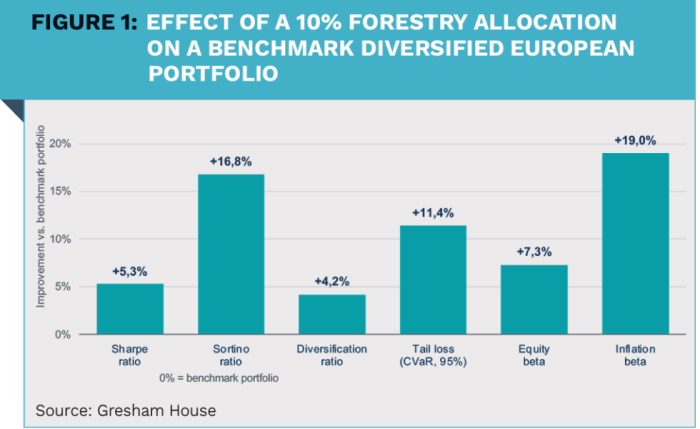
A resilient forest draws strength from diversity, across species, locations, timber grades and income sources. Indeed, the same principle applies at the portfolio level. To illustrate forestry’s potential contribution to an institutional portfolio, we modelled the effect of introducing a 10% forestry allocation into a diversified benchmark comprising global equities (35%), European equities (10%), US bonds (10%), European bonds (30%), infrastructure (5%), European REITs (5%), and US inflation-linked bonds (5%). The analysis used annual data from 2000 to 2025.
In this model, the allocation increased the Sharpe ratio by 5.3% and the Sortino ratio by 16.8%. It also increased the diversification ratio, a measure of the risk reduction achieved through diversification, by 4.2%, while reducing conditional value-at-risk by 11.4%. Equity beta fell by 7.3%, while inflation beta improved by 19.0%, further demonstrating forestry’s significant diversification and inflation-protection benefits. These figures represent relative changes from the benchmark rather than percentage-point movements.
The results illustrate how forestry’s differentiated return drivers might affect an already diversified portfolio. For pension funds, the appropriate allocation will ultimately depend on their liability profiles, liquidity budgets and governance capacity. A 10% allocation is large enough to influence portfolio outcomes while retaining 90% in more liquid investments, although it will not be suitable for every investor.
A question of exposure
For centuries, forests have rewarded patient owners. What has changed is not the underlying biology but the breadth of value that forestry can offer. Timber and biological growth remain at the core, supported by demand from construction, packaging and renewable materials. Renewable energy, recreation, infrastructure and environmental markets can extend the opportunity.
None of this makes forestry a simple asset. It requires skilled management, patience and a clear-eyed understanding of physical, market and liquidity risks. Nor does diversification eliminate the possibility of loss.
The strongest case for pension funds may nevertheless emerge at portfolio level. Forestry provides exposure to biological growth, timber markets and active land management, return drivers that differ from those dominating most traditional portfolios.
Trees do not need reinventing; they have been compounding value for centuries. It is portfolios that may need to change. The question for trustees is whether forestry’s distinctive return drivers now deserve a greater role in theirs.
|
SUMMARY Forestry has a long track record of creating value. The range of additional potential value sources include renewable energy, recreation, infrastructure and environmental markets. Forestry requires skilled and patient management, given its physical, market and liquidity risks. Forestry offers return drivers that differ from those of traditional asset classes and has diversification potential |
Read the full article in the online magazine