
Ortec Finance: From scenario analysis to strategic decisions

This article was originally written in Dutch. This is an English translation
Climate scenarios are essential for strategic decision-making by pension funds. But are the widely used NGFS scenarios sufficient to provide insight into the financial impact of climate risks and portfolio vulnerabilities?
By Tijmen Janssen and Hidde Andringa
DNB emphasises that pension funds must identify, measure and manage climate and environmental risks as part of their risk management. When managing climate risks, pension funds generally make use of implementation tools such as voting policy, engagement, the exclusion of companies and impact investing, rather than measures at a strategic level.
Climate scenario analyses play an important role in gaining insight into the potential long-term consequences of climate change for the portfolio. Scenarios enable pension funds to examine how different climate transition pathways might affect strategic asset allocation, the risk budget and investment policy.
In practice, climate scenarios from the Network for Greening the Financial System (NGFS) are often used for this purpose. These scenarios form an internationally accepted framework of reference and allow for the comparison of results across countries and institutions. Whilst this standardisation is valuable for reporting and benchmarking purposes, it does not necessarily mean that NGFS scenarios are equally suitable for every application. When scenario analyses are used to support strategic portfolio decisions, they must be sufficiently distinctive to highlight material vulnerabilities. If the outcomes differ only slightly between scenarios and do not prompt a reassessment of allocation choices, risk budgets or investment policy, the added value for a pension fund’s strategic decision-making is limited.
Target audience and application of different scenarios
A key difference between NGFS scenarios and alternative financial climate scenarios lies in their intended target audience. NGFS scenarios are primarily developed for central banks, regulators and analyses of the financial system as a whole1. The focus is therefore on macroeconomic consistency, international comparability and the assessment of financial system risks. For asset owners and asset managers, the question is often more specific: what do physical risks, transition risks and potential financial market reactions mean for a multi-asset portfolio? Pension funds are better off using scenarios designed with that portfolio context as a starting point, and which translate climate pathways into inflation, interest rates and returns broken down by region, sector and asset class. This focus is better aligned with the strategic decision-making processes used by pension fund board members.
Physical risks as the most significant risk factor for asset owners
For asset owners, and in particular pension funds with a long investment horizon, physical climate risks are among the most material risk factors. These risks do not only affect property or infrastructure, but can impact virtually all investment categories through lower productivity, disruption to supply chains and higher inflation.
Precisely because these effects manifest themselves through multiple economic channels, the way in which physical climate risks are modelled is of great importance. In climate scenarios, this is usually done using damage functions. These translate climate-related variables, such as rising temperatures or extreme precipitation, into economic damage. Small differences in the underlying assumptions can lead to significant differences in the estimated economic damage, inflationary effects and, ultimately, the expected returns on asset classes.
The choice of a climate scenario must be based on the purpose of the analysis.
The NGFS scenarios use damage functions that largely assume linear relationships between climate change and economic damage. This approach has long been the subject of debate in the climate science and economic literature2, as it is argued that it fails to take sufficient account of complex processes within the climate system and the potential consequences of climate-related tipping points. Climate scientists therefore advocate the use of more non-linear damage functions that incorporate such dynamics more explicitly.
Figure 1 shows alternative damage functions with a logistic (S) shape, which explicitly account for the possibility of non-linear climate effects. With limited warming, approximately 1 to 2.5°C, the damage projections are still close to those of the damage functions used by the NGFS. However, as global temperatures rise further, critical thresholds or tipping points may be reached, causing economic damage to increase disproportionately. In contrast to the linear NGFS approach, in which the marginal damage per additional degree of warming remains relatively constant, these functions imply that the economy and the climate system may become increasingly sensitive to further temperature rises. As a result, the economic consequences at higher levels of warming may turn out to be considerably greater than in the NGFS projections. This also applies to the current projections of the most likely warming3.
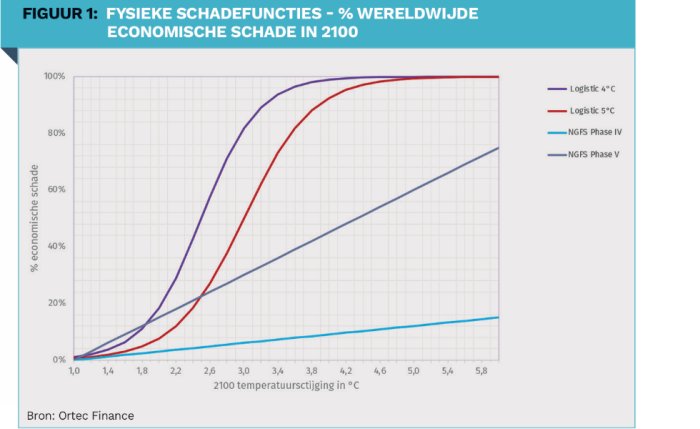
In the most recent version of the NGFS scenarios (Phase V), the methodology has been significantly refined. This results in substantially higher shocks than in previous versions. However, the linear nature of the damage function remains unchanged and still assumes gradually increasing damage with additional warming. Furthermore, the publication on which this model development is based was recently retracted by the journal *Nature* due to methodological errors4.
Choosing the right scenarios
The choice of a climate scenario must therefore start with the purpose of the analysis. If the fund’s primary aim is to meet the regulator’s minimum requirements, reporting obligations and ensure external comparability, the use of NGFS scenarios is the obvious choice. These scenarios provide a recognisable and widely accepted framework, even if there is debate regarding the underlying assumptions for physical damage. However, as soon as a scenario analysis is used as input for strategic decision-making, recognisability alone is not sufficient. In such cases, the scenario must also highlight where the vulnerabilities in the portfolio lie and how risks may propagate across different asset classes, in order to assess the current strategic allocation.
For this strategic application, additional or alternative scenarios are often required: scenarios designed to translate the analysis into the investment portfolio whilst incorporating stricter assumptions regarding physical risks and non-linear economic effects. The aim is not to deviate from the NGFS for the sake of deviation itself, but to ensure that the analysis yields sufficiently insightful results to effectively assess investment policy, risk budgets and strategic asset allocation.
|
SUMMARY Climate risks are managed by pension funds primarily during the implementation phase of the investment process. Climate scenarios can help to assess climate risks strategically. The value of scenario analysis depends on how well it aligns with the research question. NGFS scenarios offer comparability, but do not always provide sufficient insight into financial materiality. For strategic decisions, scenarios must explicitly demonstrate the impact on multi-asset portfolios. |
1 Origin and Purpose | Network for Greening the Financial System
2 Emperor’s New Climate Scenarios – a warning for financial services
3 CAT Thermometer | Climate Action Tracker
4 Nature Retracts Study Predicting Catastrophic Climate Toll - The New York Times
Read the article in the digital magazine