
Harry Geels: Do not present opinions as scientific facts

This column was originally written in Dutch. This is an English translation.
By Harry Geels
Scientists’ views find their way into all manner of public debates, whether solicited or unsolicited. In doing so, we are increasingly seeing a troubling blurring of the lines between opinions and facts.
During the latest political debate on the new tax plan and the accompanying, now infamous, ‘amendment’, PRO leader Jesse Klaver justified the additions to the plan by saying that – by asking millionaires for a little extra money and reducing the tax burden on labour in return – we are making society ‘fairer’. It sounds fair, but if there’s one term that’s a catch-all, it’s ‘fairness’. We shouldn’t be surprised when politicians use such empty terms. It becomes more jarring when scientists do so.
Science or world view?
A few weeks ago, whilst waiting in the reception area of a museum, my eye fell on an article from *Geschiedenis Magazine* by a lecturer at Leiden University. In it, he reported on what happened historically – in this case in wealthy city-states in Italy – when higher wealth taxes were introduced. I nearly fell off my chair at the unscientific nature of the article. It was full of opinions and catch-all terms. Incidentally, those taxes failed at the time because ‘the elite would rather protect their own position than act in the public interest’ – at least, that was the gist of it.
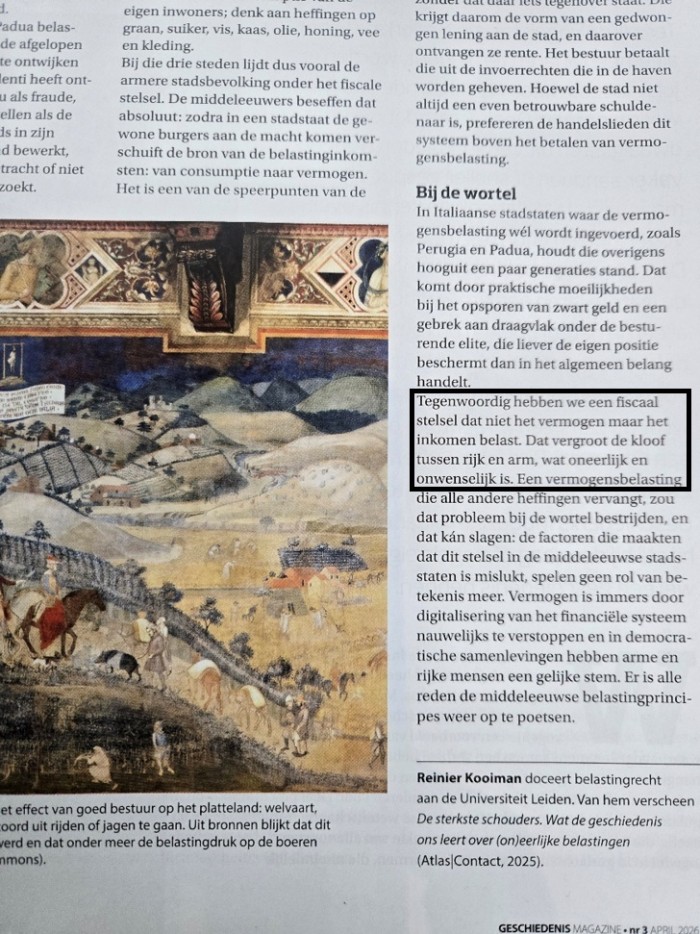
Where this academic really went over the top was in the following passage: ‘Nowadays, we have a tax system that taxes income rather than wealth. This widens the gap between rich and poor, which is unfair and undesirable.’ Firstly, the claim that we do not tax wealth is incorrect. In fact, one could argue that income from wealth is actually taxed particularly heavily.
Suppose an investor achieves a 6 per cent nominal return, whilst inflation erodes their purchasing power by 3 per cent and the tax on their wealth effectively amounts to a further 2 per cent. This leaves them with approximately 1 per cent of their nominal return. Anyone who regards inflation as an implicit tax on nominal returns could therefore even argue that over 83 per cent of that return is wiped out by taxation. You do not have to agree with this approach. But it does demonstrate how unscientific it is to simply state, without further definition, that wealth is not taxed.
Secondly, there is the claim that the absence of taxation on wealth (but not on labour) widens the gap between rich and poor. That is an empirical hypothesis. You can conduct research into it and then debate definitions, causality and evidence. There may be supporting evidence, but there is also plenty of counter-evidence. Economics is not an exact science. Thirdly, there are the words ‘which is unfair and undesirable’. This is nothing more than a normative judgement using vague, catch-all terms. What, for example, is meant by fairness? Does that not boil down to greater equality? And if so, what form: equality before the law, equality of opportunity, or equality of outcome?
Facts or opinions? More examples
Anyone who reads on to the end of the article will see yet another opinion presented as a scientific fact: ‘A wealth tax that replaces all other levies would tackle that problem at its root…’ I suspect that by ‘the problem’, the author means the problem of inequality (which thus remains undefined). The claim that introducing further wealth taxes (which we already have, and in abundance!) and abolishing all other taxes would solve inequality is nothing more than an empirical hypothesis about which we can debate.
The article mentioned above is striking, but there are many more examples of academics confusing opinions with facts. For instance, on Leiden University’s website we also find an article entitled ‘Fair taxation for billionaires is needed’. That title, too, is nothing more than a judgement using a catch-all term that could have come straight from the mouth of a politician. The argument is underpinned by statements from two professors: the Frenchman Gabriel Zucman, recently hailed as a ‘rock star’ in the House of Representatives, and the Dutchman Egbert Jongen.
Activism
Alongside vague normative economics, in which academics explain to us what is fair and desirable, there is an even more extreme form: academics with an activist agenda. They translate a normative conclusion – for example, that wealth taxes are fairer than income taxes – into a drive for social or political change. Activist academics are also socially engaged, for example in political parties’ think tanks or as directors of ‘public benefit’ organisations.
I find activism difficult to reconcile with the special position of the academic. Not because a professor is not allowed to hold political convictions, but because he can never completely separate those convictions from the authority conferred upon him by his academic title. It was not without reason that the American sociologist Robert Merton counted ‘disinterestedness’ and ‘organised scepticism’ amongst the core values of science: the researcher must be prepared to accept any outcome, particularly when it contradicts their own convictions.
The activist, by contrast, starts with a desired social outcome and seeks to bring it about. This raises a second problem. As soon as a professor intervenes in the public debate as an activist, a normative judgement easily acquires the authority of a scientific conclusion. The public, the media and policymakers are, after all, susceptible to such appeals to authority. Precisely those who possess the privilege of scientific authority should therefore be extremely cautious about using that authority for political purposes.
Finally: where does science end?
Scientists may, of course, hold political convictions. However, this also entails a responsibility. A scientist should make it clear where their research ends and their worldview begins. What do we know, what do we suspect, what do we believe, and what do we want? Anyone who allows those boundaries to blur not only runs the risk of wrongly lending their own opinion the weight of science, but ultimately also undermines the authority of science itself. In the US, trust in science has already declined. Let us try to prevent that from happening in the Netherlands.
This article contains a personal opinion by Harry Geels